
PEMF Sage Blog
PEMF Sage exists to provide clear, conservative, and evidence-aligned education about pulsed electromagnetic field (PEMF) therapy. In a space where marketing language often outpaces research, our mission is simple: explain what PEMF therapy is, how it is theorized to interact with biological systems, and what current scientific literature actually supports.
We do not present PEMF therapy as a cure, treatment, or replacement for medical care. Instead, we focus on physiology, research interpretation, safety considerations, and structured buying guidance for readers who want to make thoughtful decisions in the home wellness space.
If you are new to the topic, start with our foundational overview: What Is PEMF Therapy?. For readers evaluating devices, our in-depth Best PEMF Devices & Mats (2026 Buyer’s Guide) provides structured comparisons grounded in conservative criteria.
Because PEMF is discussed across wellness and clinical contexts, our default is restraint: we separate what is well-established physiology from what is still being explored in research. When evidence is limited or mixed, we say so plainly and avoid turning early-stage findings into broad promises.
What PEMF Therapy Is — and What It Is Not
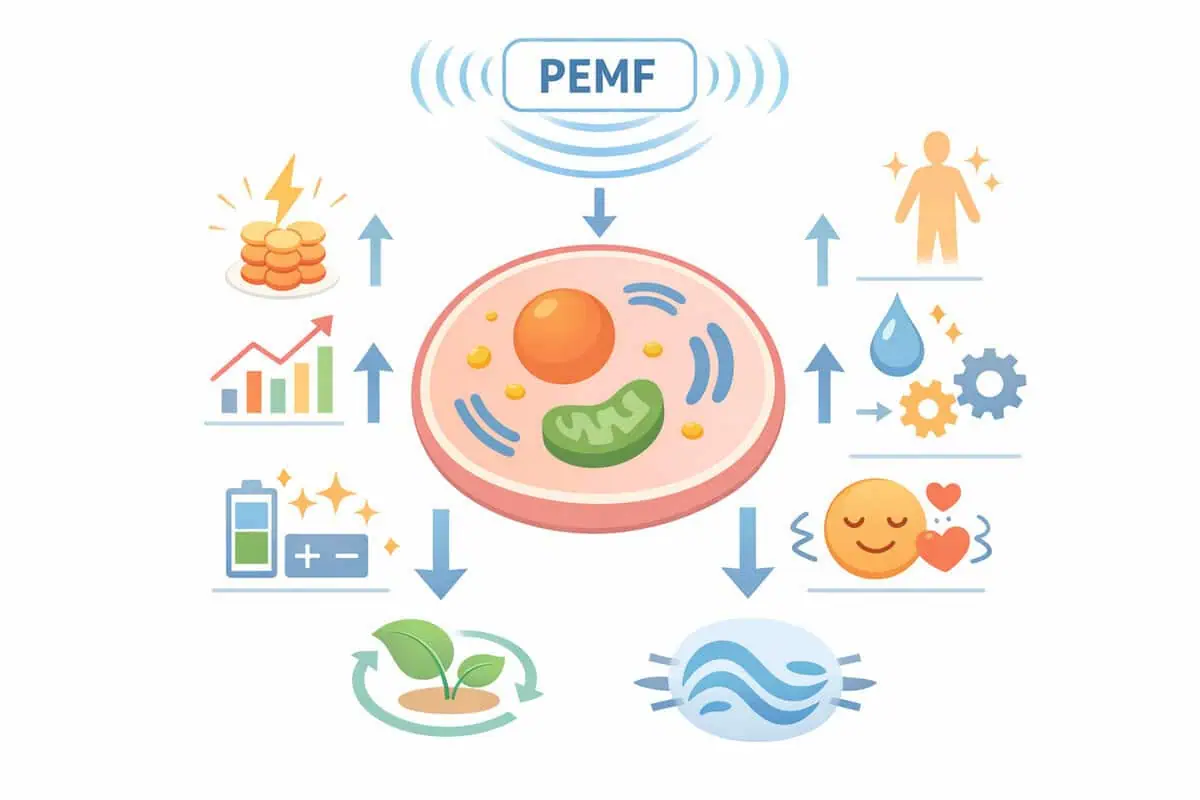
Pulsed electromagnetic field therapy uses low-frequency electromagnetic signals delivered in controlled pulses. These signals are designed to interact with the body at a cellular level. Research discussions often focus on membrane potential, ion exchange, and cellular signaling patterns.
In practice, “pulsed” is a key word. PEMF devices do not simply emit a constant field; they deliver signals in timed bursts that may vary by waveform shape, frequency (often discussed in Hz), intensity, and program duration. These settings can change how the signal is delivered, but they do not automatically translate into predictable outcomes for every person or use case.
PEMF is also used as a broad label. Some products emphasize full-body exposure through mats, while others focus on targeted applicators. Some devices publish detailed technical specs; others describe benefits without explaining the signal. PEMF Sage treats this difference as meaningful because transparency affects how responsibly a device can be evaluated.
Importantly, PEMF is not the same as a medical treatment plan. A wellness device may be used as part of a routine, but it should not be framed as replacing clinical care, diagnosis, or professional guidance. Our content is written to help readers understand the category and make adult decisions with appropriate caution.
Importantly, PEMF Sage distinguishes between:
- Laboratory or mechanistic findings
- Clinical exploration
- Marketing claims
We do not equate exploratory findings with guaranteed outcomes. Instead, we explain mechanisms conservatively, clarify evidence strength, and separate possibility from proof.
A practical way to think about our editorial stance is this: physiology can explain how a signal might matter, but research is what determines whether it reliably matters for specific outcomes. When those two are conflated, claims tend to become overstated. PEMF Sage exists to keep that separation clear.
How PEMF Is Theorized to Interact with the Body

Much of the discussion around PEMF therapy centers on its potential interaction with:
- Ion channel behavior
- Cell membrane voltage regulation
- Microcirculatory dynamics
- Mitochondrial energy processes
- Nervous system signaling balance
These areas are grounded in established physiological principles. However, translating cellular theory into broad wellness claims requires caution. PEMF Sage prioritizes explaining mechanisms in their proper context without overstating implications.
One reason mechanisms are often discussed is that cells rely on electrochemical gradients to function. Membrane potential helps regulate how ions move, how signals are transmitted, and how tissues maintain normal homeostasis. A pulsed electromagnetic signal is theorized to interact with these processes indirectly, but the body is complex and responses vary based on signal parameters and individual factors.
When we discuss microcirculation, we are describing the dynamics of small vessels and capillary-level flow. This is frequently referenced in PEMF conversations because tissue oxygenation and nutrient exchange depend on circulation. Still, “supports circulation” is often used too broadly online; we keep language conservative and focus on what is plausible, what is measured, and what remains uncertain.
For a deeper technical explanation, visit: How PEMF Therapy Works at the Cellular Level.
Evidence Alignment & Research Transparency

Our content references publicly available research and institutional summaries. When appropriate, we align explanations with materials from:
- National Institutes of Health (NIH)
- PubMed-indexed research publications
- Cleveland Clinic
- Mayo Clinic
We distinguish between:
- FDA-cleared medical applications
- Home wellness devices
- Experimental or emerging technologies
Readers can explore our evidence-focused review here: PEMF Therapy Research: What the Evidence Actually Shows.
A key part of research transparency is understanding what a study actually tested. PEMF research can vary widely by population, device parameters, exposure time, and outcome measures. A positive result under one set of conditions does not automatically generalize to every home device, every intensity level, or every reason someone might be interested in PEMF.
PEMF Sage also separates evidence strength into practical tiers:
- Mechanistic plausibility: physiology-aligned concepts that describe how signals might interact with biological systems
- Clinical exploration: human research that suggests potential outcomes under defined conditions
- Real-world application limits: what remains unknown when devices, settings, and populations differ from controlled studies
This tiered approach helps avoid a common problem in wellness marketing: treating “there is research” as equivalent to “this will work for you.” Our goal is to help readers understand what research can reasonably support and where it cannot.
Safety & Conservative Use Principles

PEMF therapy is generally discussed as non-invasive. Still, responsible education requires attention to:
- Contraindications (such as implanted electronic devices)
- Pregnancy considerations
- Unsupervised use in medical conditions
- Appropriate session duration and intensity
We provide detailed safety guidance in our dedicated page: PEMF Therapy Safety, Risks & Contraindications.
Our approach emphasizes informed decisions, physician consultation when appropriate, and gradual adoption rather than aggressive usage patterns.
A conservative approach also includes setting realistic expectations for “what’s normal.” Some people report feeling nothing noticeable during a session; others may notice mild, non-specific sensations related to posture, relaxation, or the routine itself. A lack of sensation does not prove lack of effect, and a sensation does not prove a specific effect. This is why safety guidance and evidence interpretation matter.
If you are considering PEMF alongside a medical condition, prescription devices, or implanted hardware, the appropriate step is to consult a qualified clinician who understands your situation. PEMF Sage provides educational framing, not personalized medical instructions.
Buying Guidance Without Hype

PEMF devices vary widely in waveform structure, frequency range, field intensity, build quality, and price. Rather than ranking products based on exaggeration or trend cycles, PEMF Sage filters options using structured criteria:
- Manufacturer legitimacy
- Transparency of technical specifications
- Signal clarity and consistency
- Warranty and support infrastructure
- Absence of disease-specific cure claims
Our role is not to declare a single “perfect” device. Instead, we identify credible options that meet defined standards and explain who each device may be appropriate for.
If you are evaluating equipment, visit our cornerstone commercial hub: Best PEMF Devices & Mats (2026 Buyer’s Guide).
When readers compare devices, we encourage a simple first pass that prevents common mistakes:
- Match the form factor to your routine: full-body mats for consistent, passive use vs targeted applicators for localized sessions
- Confirm spec clarity: published frequency ranges, waveform descriptions, and intensity language that is specific rather than vague
- Check ownership realities: return policy, warranty terms, controller replacement availability, and long-term durability
- Prefer restraint over promises: brands that avoid cure-like claims tend to be easier to evaluate responsibly
We also consider practical usability because consistency often matters more than novelty. A device that is comfortable to set up, easy to store, and simple to run is more likely to be used routinely than one that feels complicated or burdensome.
Editorial Standards & Transparency

PEMF Sage follows a structured editorial review process. We:
- Separate educational content from commercial comparisons
- Avoid first-person anecdotal claims
- Use conservative language when describing physiological processes
- Update cornerstone content as new research emerges
Affiliate relationships, where applicable, are disclosed transparently on our Affiliate Disclosure & Monetization Policy page.
For full methodology details, see: Editorial Standards & Review Process.
Transparency also means explaining the limits of what any editorial site can do. We are not a medical provider, and we do not “test” devices in a clinical sense. Our comparisons focus on published specifications, manufacturer credibility signals, and conservative alignment with how evidence is typically discussed in institutional sources.
Explore the PEMF Sage Knowledge Base

PEMF therapy intersects with multiple areas of wellness, including circulation, recovery routines, stress regulation, and general cellular support discussions. We have organized our site to help readers move logically from foundational understanding to practical application.
If you prefer a structured path, here is a simple sequence many readers follow:
- Start with What Is PEMF Therapy? for definitions and category context
- Read PEMF Therapy Safety, Risks & Contraindications before considering devices
- Use PEMF Therapy Research: What the Evidence Actually Shows to understand evidence strength and limits
- Browse the Blog for focused educational topics (frequencies, session guidance, and practical use)
- When ready to compare devices, visit Best PEMF Devices & Mats (2026 Buyer’s Guide)
To explore all educational articles, visit our Blog. For questions, clarification, or collaboration inquiries, contact us at Contact PEMF Sage.
PEMF Sage is built as a long-term educational resource — designed for readers who prefer clarity over hype, context over claims, and structured guidance over sensationalism.
If you are unsure where to begin, choose the page that matches your intent: safety-first readers should start with the safety guide, research-focused readers should start with the evidence review, and device shoppers should begin with definitions before moving into the Buyer’s Guide. Our goal is to make each next step obvious so you can move at your own pace with appropriate caution.